The Great Fiji Shark Count

Counting Fiji's sharks, rays and turtles

  • Email
  • Facebook
  • RSS
  • Twitter
  • Home
  • Event
    • Materials
      • ID Posters
      • Logbooks
      • Instructions
    • AWARE Shark Specialty
    • Get involved
    • Instructions
    • ID Posters
    • Presentations
      • Fiji Shark Conservation and Awareness Project
  • Participants
    • Dive Centres
    • Participating Resorts
    • Supporters
    • Operator Register
  • Science
    • Why Sharks?
    • Why Rays?
    • Why Turtles?
  • Results
    • 3 Years Results 2015
    • April 2012 Results
  • Shark Info
    • Shark Lifestyle
    • Shark Biology
    • Feeding Behaviour
  • Species
    • Inshore Species
    • Offshore Species
    • Ray species
    • Shark Species
    • Turtle species
  • Partners
    • Photographers
    • eShark
    • marine ecology
    • Ocean Soaps
    • Save our Seas
    • Shark Foundation
    • Shark Reef
    • Shark Savers
    • WWF
  • News
  • Contact
You are here: Home / News / Community-driven shark monitoring for informed decision making: a case study from Fiji October 2022 – C. A. Ward-Paige

Community-driven shark monitoring for informed decision making: a case study from Fiji October 2022 – C. A. Ward-Paige

Context

Globally, more than 121 million people enjoy nature-based marine tourism, making it one of the largest marine industries. Ocean degradation threatens this industry and management has not kept pace to ensure long-term sustainability.

In response, some individuals within the industry are taking it upon themselves to monitor the ocean and provide the data needed to assist management decisions. Fiji is one such place.

Aims

Between 2012 and 2016, 39 Fijian dive operators, in collaboration with eOceans, conducted the Great Fiji Shark Count to document sharks on their dives. Methods.

Using 146 304 shark observations from 30 668 dives, we document spatial and temporal patterns of 11 shark species at 592 sites.

Key results

Sharks were observed on 13 846 dives (45% of recorded dives) at 441 (74%) sites. Generally, our results matched those from other more limited surveys, including from baited remote underwater video systems.

We found high variability in shark presence, species richness, and relative abundance through space and time.

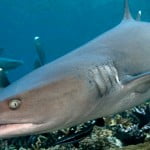
One trend was surprising: the most common species, Whitetip Reef Shark, decreased over the study period at eastern sites and increased at western sites; the cause is currently unknown.

Conclusions

Our results can guide management and conservation needs, future scientific questions, and provide a baseline for future assessments. Implications.

This study demonstrates the value of longitudinal observation data that includes absences for describing marine fauna, and confirms the capacity of stakeholders to document the ocean.

It also points the direction for broadscale participatory science methodologies to track the ocean.

Keywords: citizen science, conservation, community monitoring, elasmobranchs, endangered species, marine spatial planning, participatory science, sustainability, tourism


Community-driven shark monitoring for informed decision making a case study from Fiji PC22009_compressedDownload

Pacific Conservation Biology 29(5) 402-418 https://doi.org/10.1071/PC22009

For full list of author affiliations and declarations see end of paper

*Correspondence to: C. A. Ward-Paige eOceans, Dartmouth, NS, Canada Email: [email protected] Handling Editor: Alan Lymbery

Published: 11 October 2022

Cite this: Ward-Paige CA et al. (2023) Pacific Conservation Biology, 29(5), 402–418. doi:10.1071/PC22009

© 2023 The Author(s) (or their employer(s)). Published by CSIRO Publishing.

This is an open access article distributed under the Creative Commons Attribution- NonCommercial-NoDerivatives 4.0

International License (CC BY-NC-ND).
https://www.publish.csiro.au/PC/PC22009

Leave a Reply Cancel reply

Your email address will not be published. Required fields are marked *

I accept the Privacy Policy

This site uses Akismet to reduce spam. Learn how your comment data is processed.

Sign up for email updates

Welcome to The Great Fiji Shark Count !

Throughout the months of April and November every year, you have the opportunity to help celebrate and record Fiji’s amazing coral reef biodiversity, show you care about our world’s delicate coral reef systems, and have fun, by taking part in the FIJI-WIDE SHARK COUNT!

Easy to do, this is suitable for visitors and locals alike, whether you like to fish, snorkel, or SCUBA dive. We hope that tourists, school children, scientists and all people with an interest in the marine environment will take to the reefs with us to search for the Sharks of Fiji!

The Great Fiji Shark Count will be held across Fiji every April and November every year.

You can do a single count, or take part as many times as you like during that month, so that you cover different reefs. All data will be gratefully accepted!

So, see your resort, watersports operator or travel agent, get your Shark identification materials and dive into the beautiful blue waters of Fiji, to be a part of history!

White Tip Shark Header
Silver_TipShark_Header
Tiger_Shark_Header
Grey_reef_shark_Header

Project AWAREFiji Department of Fisheries and ForestsMarine Ecology FijiShark Reef, FIJIWorld Wide Fund for Nature WWFShark Savers
 Shark FoundationOcean SoapseSharkSave our Seas Foundation

Tags

apparel Beqa CITES conservation Coral Coast dive Dive Centre Fiji Fiji Times finning Hong Kong ID identification International Union for Conservation of Nature IUCN liveaboard Mamanuca Mananuca news Pacific Harbour PADI participant partner Project AWARE ray resort results Savusavu shark sharks species Sunshine Coast supporter Taveuni tshirt turtle USP Vanua Levu Vatu-i-Ra Yasawa

Recent News

  • Community-driven shark monitoring for informed decision making: a case study from Fiji October 2022 – C. A. Ward-Paige
  • Companions and Casual Acquaintances: The Nature of Associations Among Bull Sharks at a Shark Feeding Site in Fiji – June 2021 – Thibaut Bouveroux
  • Shark Reef Marine Reserve (SRMR) Benthic Biodiversity Assessments, Serua, Viti Levu, Fiji – September 2022
  • Shark fishing bans double reef shark numbers – study
  • Great Shark Snapshot returns for 2024
  • Rays in the Shadows: Batoid Diversity, Occurrence, and Conservation Status in Fiji

Like us on Facebook

The Great Fiji Shark Count 

© 2026 · Handcrafted with by The Army of Flying Monkeys · Privacy Policy · Privacy Tools · Get in Touch